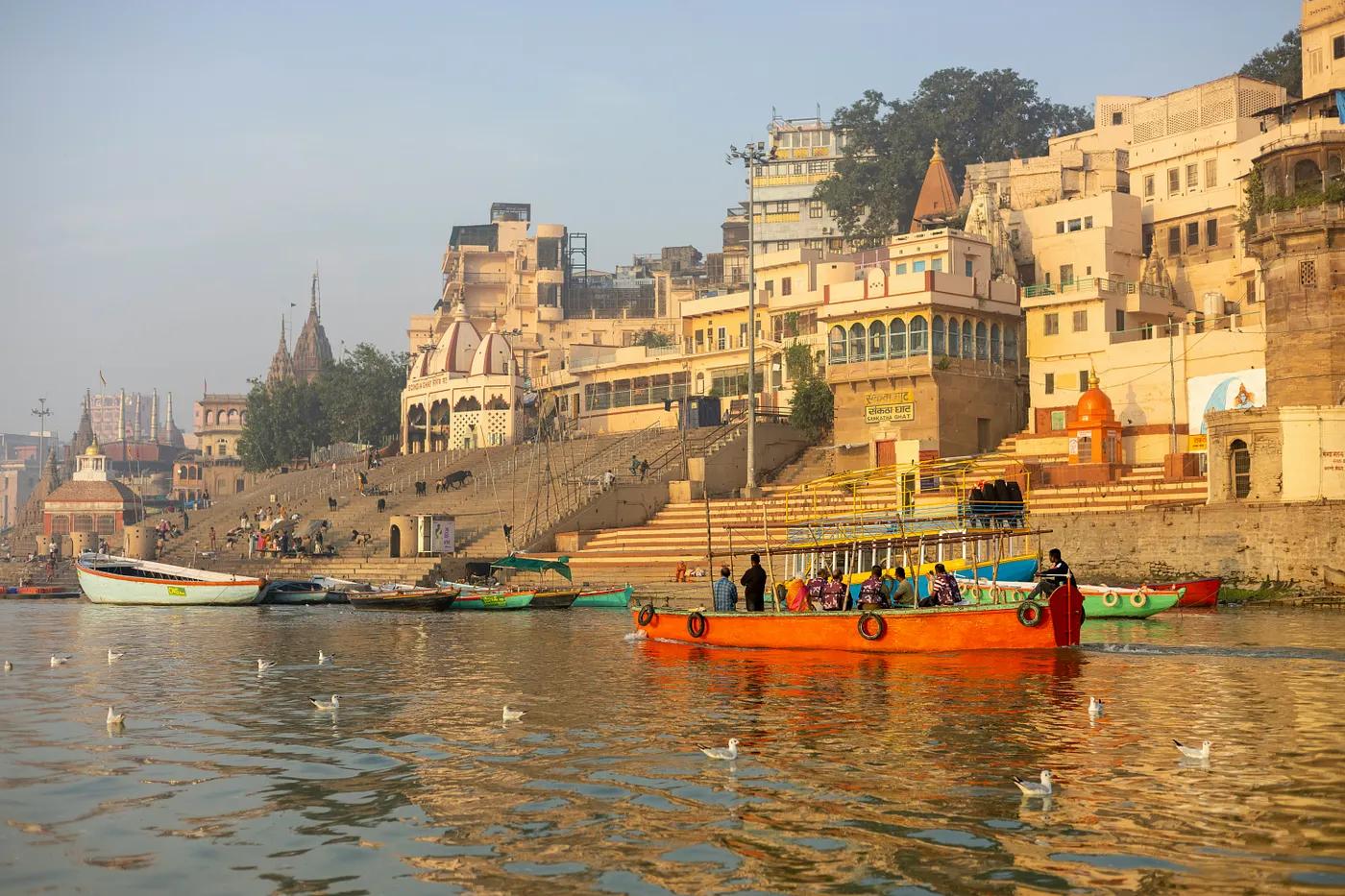
I wasn’t in Banaras for long, but long enough to understand that every step along the ghats has a price attached to it.
₹200 for a tilak of chandan on your forehead. ₹100 to leave your sandals outside a random shop. Not a locker, not even a numbered token, just a pile near a doorstep. A “VIP” boat to watch the Ganga Aarti. A VIP queue to shorten your wait for Darshan.
The city is ancient, the faith is genuine, and the economy running alongside it is remarkably efficient.
I want to be clear before I go further: I am not here to judge. Religion and commerce have coexisted in India for as long as temples have had prasad stalls. What struck me wasn’t the fact of it. It was the density of it. In Banaras, you cannot take three steps toward the divine without being offered a shortcut, an upgrade, or an enhancement for a fee.
Some of it is perfectly understandable. The ghats employ tens of thousands of priests, boatmen, flower sellers, laundry workers. Tourism sustains livelihoods that stretch back generations. When a man offers to apply chandan for ₹200, he is not swindling you. He is working.
The question I kept returning to was simpler and harder: does the packaging of devotion change what’s inside?
The queue that money can buy
The previous year, I visited Siddhi Vinayak in Mumbai. Outside the temple, more than 50 men jostled near the entrance. Not devotees, but facilitators. Each one selling access to a VIP line that would shave an hour off your wait.
The official VIP darshan exists, sanctioned by the trust. What surrounds it is an informal shadow market, built entirely on the gap between what the queue offers and what the impatient pilgrim wants.
Nobody forced anyone to buy. People handed over money willingly, happily even — grateful for the shortcut. And yet there was a quiet discomfort I couldn’t shake. The temple is, by definition, a place of equality before the deity. The idea that proximity to god can be tiered by purchasing power is not new — it’s ancient, actually, but seeing it so openly operationalised felt like something had shifted.
What I’m actually saying
I am not arguing for chaos over order, or for tourism that ignores local economies. I am not romanticising “authentic” poverty. Locals deserve to earn from the footfall their home attracts.
What I am noticing, and it is really just a noticing, not a verdict, is that there seems to be a threshold. Below it, commerce and devotion coexist without one consuming the other. Beyond it, the transaction becomes the loudest thing in the room, and what you came for: the silence, the light, the feeling of standing somewhere that has mattered for centuries, recedes behind the ticketing counter.
Banaras still has that feeling, in patches. Early mornings on the lesser ghats, before the boats arrive. Inside the narrow lanes where the chandan sellers haven’t yet set up. In those moments the city is exactly what it promises to be. I just had to find my way around the economy of it to get there.
Maybe that navigation — learning which transactions to accept, which to sidestep, how to find the unmediated moment inside the managed experience, is itself part of modern pilgrimage.
Sacred spaces have always asked something of you. These days, they sometimes ask for it in cash.